How to Create a Simple Monthly Budget
Learn how to create a simple monthly budget by organizing your income, expenses, savings, and financial goals with practical examples.
Content
Managing personal finances becomes easier when you have a clear plan for how to use your money. One of the simplest ways to organize your finances is by creating a monthly budget.
A monthly budget helps you understand how much money comes in, where your money goes, and how much you can save. It can also help you avoid unnecessary spending and prepare for future financial needs.
You do not need to be a financial expert or use complicated tools to create a budget. A simple plan based on your actual income and expenses can already make a meaningful difference.
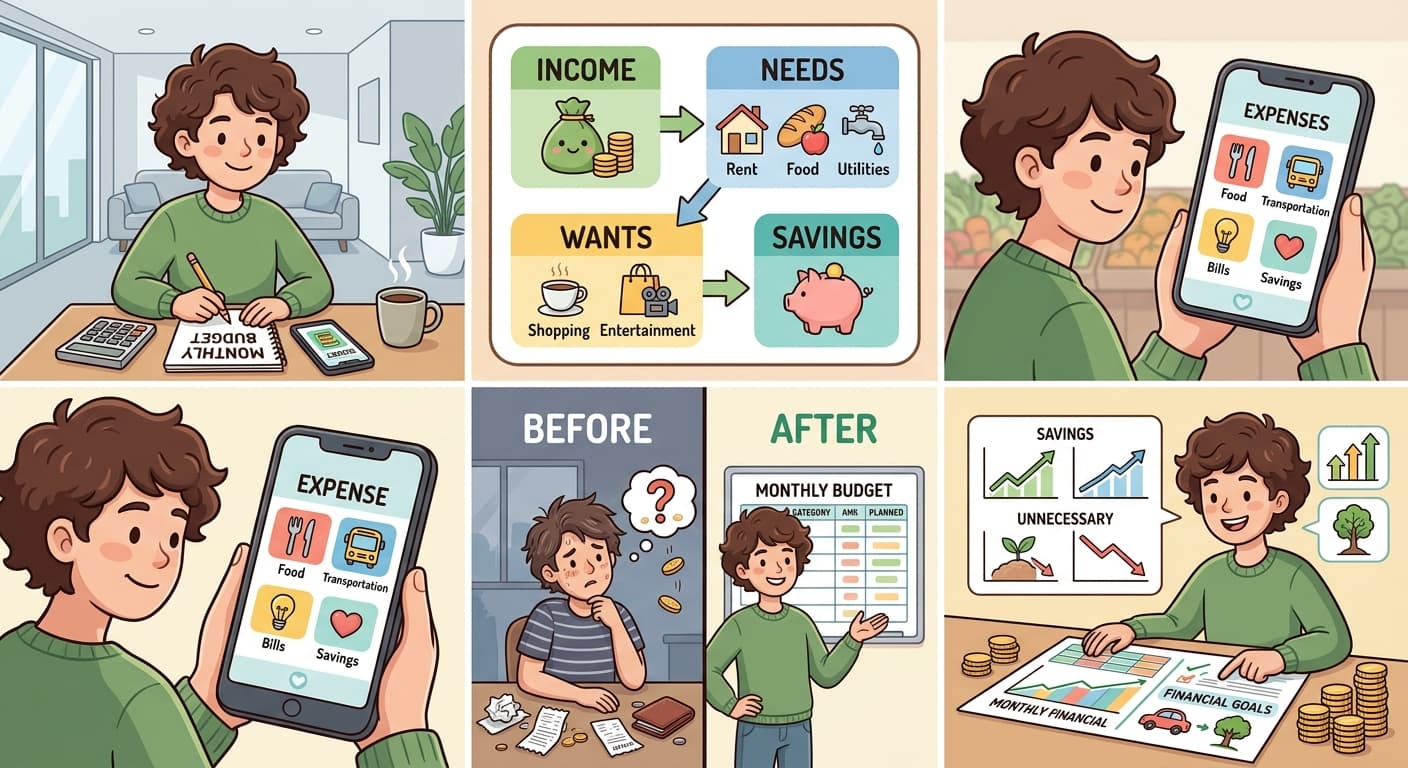
Picture suggestion: A person planning their monthly finances with a notebook, calculator, and smartphone.
What Is a Monthly Budget?
A monthly budget is a plan for managing your income and expenses over a specific month. It gives you a clear picture of how much money you have available and how you intend to use it.
A basic monthly budget usually includes three important areas:
Income: Money you receive from your salary, freelance work, business, or other sources.
Expenses: Money you spend on rent, food, transportation, bills, entertainment, and other needs.
Savings: Money you set aside for emergencies, future purchases, education, or other financial goals.
For example, if you receive $600 per month, your budget can help you decide how much should go toward essential expenses, personal spending, and savings.
The purpose of a monthly budget is not to stop you from spending money. Instead, it helps you spend according to your priorities and financial situation.
How to Create a Simple Monthly Budget
1. Calculate Your Monthly Income
The first step in creating a monthly budget is knowing how much money you have available.
Write down all your regular sources of income.
For example:
Income Source Amount Salary $500 Freelance Work $100 Total Income $600
If your income changes from month to month, it can be useful to create your budget based on a conservative estimate rather than assuming your highest possible income.
This can help you avoid planning expenses around money you may not actually receive.
2. List Your Monthly Expenses
After calculating your income, list your expected expenses.
It can be helpful to divide them into needs and wants.
Needs may include:
Rent or housing
Food
Electricity and water
Transportation
Phone and internet
Healthcare
Loan or debt payments
Wants may include:
Eating at restaurants
Shopping
Entertainment
Subscriptions
Hobbies
Non-essential purchases
This separation helps you understand which expenses are essential and which ones could potentially be reduced if your budget becomes tight.
Picture suggestion: Simple financial illustration showing “Income → Needs → Wants → Savings.”
3. Set a Savings Amount
Savings should be included in your monthly budget instead of being treated as money you save only if something is left at the end of the month.
For example, if your monthly income is $600, you could decide to save $60 each month.
Your savings might be used for:
Emergency expenses
Education
A future purchase
Travel
Starting a business
Long-term financial goals
The amount you save will depend on your income, expenses, and financial goals. The important thing is to choose an amount that is realistic and sustainable.
Even a small amount saved consistently can help you develop better financial habits.
4. Create Your Monthly Budget
Once you know your income, expenses, and savings target, put everything together.
For example:
Category Monthly Amount Total Income $600 Rent $150 Food $120 Transportation $50 Bills & Internet $50 Entertainment $40 Other Expenses $30 Savings $60 Total Planned Expenses $500 Remaining Amount $100
In this example, the person has $100 remaining after the planned expenses and savings.
Instead of spending the entire amount, they could divide it between additional savings, debt repayment, or keeping it available for unexpected expenses.
A good monthly budget should leave some flexibility because unexpected costs can happen.
5. Track Your Actual Spending
Creating a monthly budget is only the beginning. Tracking your actual spending helps you understand whether you are following your plan.
For example, you planned to spend $120 on food, but after two weeks you have already spent $90.
That means you have only $30 remaining for food for the rest of the month.
This information allows you to adjust your spending before the month ends.
You can track your expenses using:
A notebook
Excel or Google Sheets
A budgeting application
Your bank or financial service application
A simple expense-tracking system on your phone
The important thing is to record expenses consistently.
Picture suggestion: Smartphone displaying a simple expense-tracking screen with categories such as food, transportation, bills, and savings.
6. Review Your Monthly Budget
At the end of each month, compare your planned budget with your actual spending.
For example:
Category Planned Actual Difference Food $120 $135 +$15 Transportation $50 $45 -$5 Entertainment $40 $60 +$20 Savings $60 $60 $0
This comparison helps you identify where your spending is higher or lower than expected.
If you consistently spend more on entertainment, for example, you may decide to reduce that category next month.
A monthly budget should not be considered a fixed rule. It should be reviewed and adjusted as your financial circumstances change.
Practical Example: Creating a Monthly Budget With $600 Income
Let's look at a practical example.
Dara earns $600 per month. Before creating a budget, he often spends money without tracking it and sometimes has very little money left at the end of the month.
He decides to create a monthly budget.
His plan is:
Rent: $150
Food: $120
Transportation: $50
Bills and internet: $50
Entertainment: $40
Other expenses: $30
Savings: $60
His planned spending and savings total $500, leaving $100.
Dara decides not to spend the entire remaining $100. Instead, he keeps $50 as a buffer for unexpected expenses and adds the other $50 to his savings if he does not need it.
After following this monthly budget for several months, Dara can better understand his spending patterns and build a stronger savings habit.
The example shows that budgeting is not necessarily about spending less on everything. It is about knowing where your money goes and making decisions based on your priorities.
Picture suggestion: Before-and-after financial illustration showing unplanned spending versus a structured monthly budget.
Common Mistakes When Creating a Monthly Budget
Even a simple budget can become difficult to maintain if certain mistakes are made.
Not including small expenses
Small purchases such as snacks, coffee, delivery fees, or subscriptions can add up over a month. Include them when tracking your spending.
Setting unrealistic limits
A budget that is too strict may be difficult to follow. Set limits based on your real financial situation.
Forgetting unexpected expenses
Unexpected repairs, medical costs, or other urgent expenses can affect your budget. Keeping a small financial buffer can help.
Saving only what is left
If you wait until the end of the month to save, you may find that there is little or nothing remaining. Consider including savings directly in your monthly budget.
Not reviewing the budget
Your income and expenses may change over time. Review your monthly budget regularly and make adjustments when necessary.
Simple Tips for Managing Your Monthly Budget
A few consistent habits can make budgeting easier:
Track your spending: Know where your money is going.
Prioritize essential expenses: Take care of important financial obligations first.
Set realistic savings goals: Choose an amount you can maintain consistently.
Limit unnecessary spending: Review purchases and identify areas where you can reduce costs.
Keep an emergency buffer: Set aside some money for unexpected situations.
Review your budget every month: Use your previous spending to make your next budget more accurate.
Why a Monthly Budget Matters
A monthly budget can provide a clearer understanding of your financial situation. Instead of simply asking, “Where did my money go?” you can look at your income and expenses and make informed decisions.
Over time, budgeting can help you:
Improve spending awareness
Build regular savings habits
Prepare for unexpected expenses
Reduce unnecessary spending
Work toward financial goals
Make better financial decisions
Budgeting is not about achieving perfection. It is about developing a system that helps you understand and manage your money.
Picture suggestion: Person reviewing a monthly financial plan with savings and expense charts.
Conclusion
Creating a monthly budget is a simple way to organize your finances and understand how your income is being used. By calculating your income, listing your expenses, setting a savings goal, tracking your spending, and reviewing your results each month, you can build stronger financial habits.
A useful budget should be realistic, flexible, and based on your actual financial situation. Start with a simple plan and improve it as you learn more about your spending habits.
If you are looking for support with managing your financial needs, Delightech provides financial services designed to help customers manage their financial needs and access appropriate financial solutions. You can learn more about the services available from Delightech.com.kh