Financial Literacy: How to Manage Your Money Wisely
Learn the importance of financial literacy and discover practical ways to manage your money, build healthy financial habits, save regularly, and borrow responsibly.
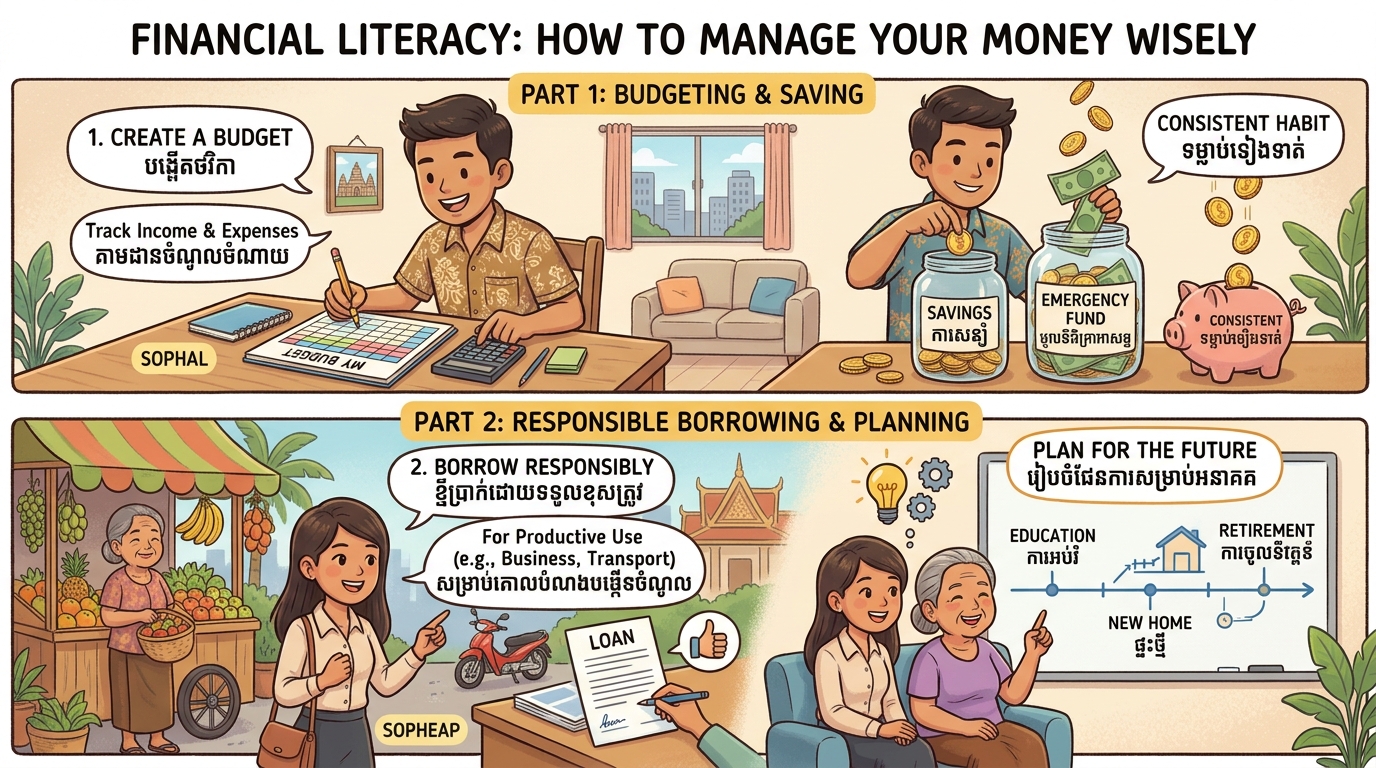
Financial literacy is an important life skill that helps people understand how to manage their money and make informed financial decisions. It includes knowledge about budgeting, saving, spending, borrowing, and planning for the future. Having good financial literacy does not necessarily mean having a high income. Instead, it means understanding how to use your available financial resources wisely.
1. Budgeting and Tracking Expenses
One of the first steps in improving financial literacy is learning how to create a budget. A budget allows you to track your income and expenses and understand where your money is going. By separating essential expenses from non-essential spending, you can make better decisions and avoid spending more than you can afford.
Practical Example: If you earn a monthly income of $400, you can follow the 50/30/20 budgeting rule by allocating $200 (50%) to essentials (rent, food, utilities), $120 (30%) to personal spending (entertainment, dining out), and $80 (20%) toward savings or debt repayment.
2. Regular Savings and Emergency Funds
Saving is another important part of good financial management. Setting aside money regularly can help you prepare for unexpected expenses and future financial goals. Even small savings can become valuable over time when saving becomes a consistent habit.
Practical Example: Cutting back on a daily $2 coffee or non-essential snack allows you to save $60 a month, which adds up to $730 a year. This money can be set aside as an "Emergency Fund" to cover sudden medical bills or job loss without having to borrow.
3. Responsible Borrowing
Financial literacy also includes understanding responsible borrowing. Loans and other financial services can be useful when they are used carefully and for appropriate purposes. Before borrowing, it is important to understand the repayment terms, interest, fees, and your ability to make repayments on time.
Practical Example: Taking out a $1,000 loan to buy a motorcycle for work commuting or starting a small trade is "good debt" because it generates income. In contrast, borrowing $1,000 to buy the latest flagship smartphone is "bad debt" because it is a depreciating asset that generates no returns.
4. Planning for Future Goals
In addition, planning ahead can help you achieve your financial goals. Whether you are saving for education, a business opportunity, an important purchase, or an emergency, having a clear financial plan can help you make more informed decisions.
Practical Example: If your goal is to launch a small business or enroll in a professional course in 2 years that requires $2,400 in startup capital, breaking it down into a targeted saving goal of $100 per month will keep you on track.
At Delightech, we understand the importance of responsible financial management. We provide financial services designed to help customers access suitable financial solutions while encouraging responsible borrowing and informed financial decisions. Learning more about financial literacy can be the first step toward building healthier financial habits and a more secure financial future.